The Ultimate Guide to Candlestick Patterns for Crypto Day Traders
5/3/2026
Introduction
In the fast-paced world of cryptocurrency trading, where volatility is the only constant, understanding the language of the market is vital. For traders on platforms like Binance, Bitget, and MEXC, the most fundamental language is the Japanese Candlestick. Developed in the 18th century to track rice prices, these patterns now provide real-time insights into the battle between "bulls" (buyers) and "bears" (sellers).
A candlestick isn't just a green or red bar; it is a visual representation of market psychology. By mastering these patterns, a trader can move away from "guessing" and start identifying high-probability entry points, exact stop-losses, and realistic profit targets. In this guide, we will break down the essential patterns every crypto trader needs to survive and thrive in 2026.
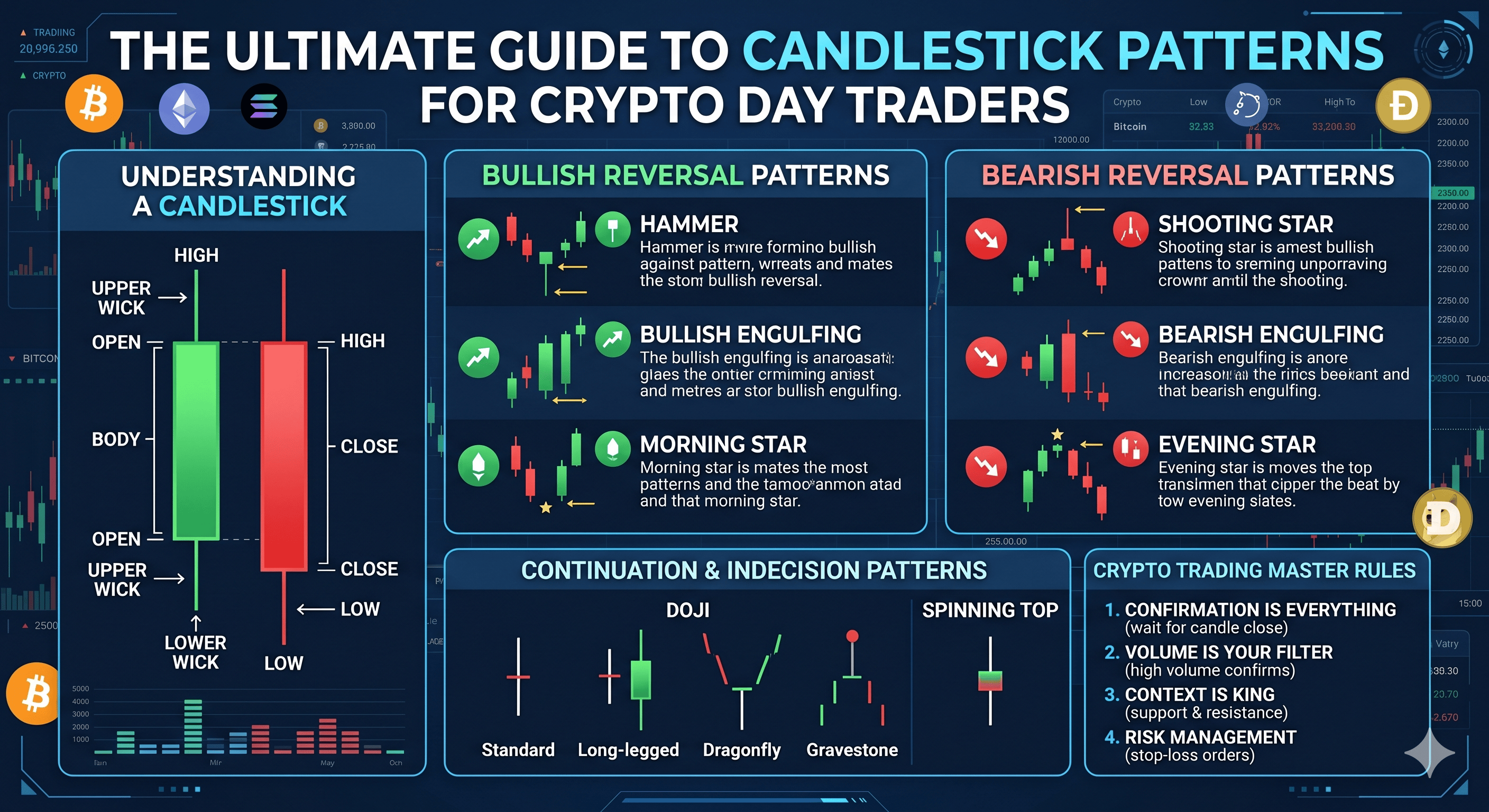
1. Anatomy of a Candlestick
Before diving into patterns, you must understand what a single candle tells you. Every candle represents a specific timeframe (e.g., 15-minute, 1-hour, or 1-day).
The Body: The thick part of the candle. It shows the range between the opening and closing prices.
The Wicks (Shadows): The thin lines above and below the body. These show the highest and lowest prices reached during that period.
Color: Green (or white) usually indicates a price increase, while red (or black) indicates a price decrease.
When you see a long wick on a MEXC chart, it often indicates "price rejection," meaning the market tried to push in one direction but was aggressively pushed back by the opposing side.
2. Top Bullish Reversal Patterns
These patterns suggest that a downtrend is losing steam and a price bounce is likely.
The Hammer
The Hammer has a small upper body and a long lower wick (at least twice the size of the body). It appears at the bottom of a downtrend.
The Psychology: Sellers pushed the price down, but buyers stepped in forcefully to close the price near the open.
Trading Tip: If you see a Hammer forming on the Bitget BTC/USDT 4-hour chart, it's a strong signal to look for a long entry.
The Bullish Engulfing
This is a two-candle pattern. A small red candle is followed by a much larger green candle that completely "engulfs" the previous one.
The Psychology: This indicates a massive shift in sentiment. The bulls have completely overwhelmed the bears.
3. Top Bearish Reversal Patterns
Identifying these can save your capital by signaling when to exit or when to open a "Short" position.
The Shooting Star
The opposite of a Hammer. It has a long upper wick and a small lower body at the top of an uptrend.
The Psychology: Buyers tried to push the price to new highs, but they ran out of gas, and sellers pushed the price back down. This often precedes a crash.
The Bearish Engulfing
A small green candle is engulfed by a large red candle. This is a common sight on Binance right before a major resistance level causes a sell-off.
4. Continuity Patterns: The Doji and Spinning Top
Not every candle means the price is about to flip. Some signify Indecision.
The Doji: This candle has almost no body—the open and close prices are the same. It looks like a cross. It means the market is neutral. If a Doji appears after a long rally, be careful; the trend is tiring out.
Spinning Tops: These have small bodies and equal wicks. Like the Doji, they represent a "tug-of-war" where neither side is winning.
5. Integrating Candlesticks with Your Trading Strategy
To get the "Exact Entry" and "Stop Loss" values your webapp aims for, you shouldn't trade candles in isolation.
Context is King: A Hammer at a major Support Level is 10x more powerful than a Hammer in the middle of nowhere.
Volume Confirmation: Always look at volume. If a Bullish Engulfing happens on high volume, it is a much more reliable signal.
The Rule of Three: Wait for the next candle to confirm the pattern. If you see a Hammer, wait for the next candle to close above the Hammer’s high before entering.
6. Risk Management and Setups
When you identify a bullish pattern:
Entry: Just above the high of the pattern candle.
Stop Loss: Just below the lowest wick of the pattern.
Take Profit: Aim for the next major resistance level, ensuring at least a 1:2 risk-to-reward ratio.
Using a signal tool (like the one you are building) allows you to automate this detection across Binance, Bitget, and MEXC simultaneously, ensuring you never miss a breakout.
Conclusion
Candlestick patterns are the pulse of the crypto market. While they are not crystal balls, they provide a statistical edge that separates professional traders from gamblers. As you build your webapp, remember that these visual cues are the first step in the technical analysis chain, followed by indicators like RSI and moving averages.
Disclaimer: This guide is for educational purposes only. Cryptocurrency trading involves extreme risk and volatility. Do not trade money you cannot afford to lose.